Five Centilitres
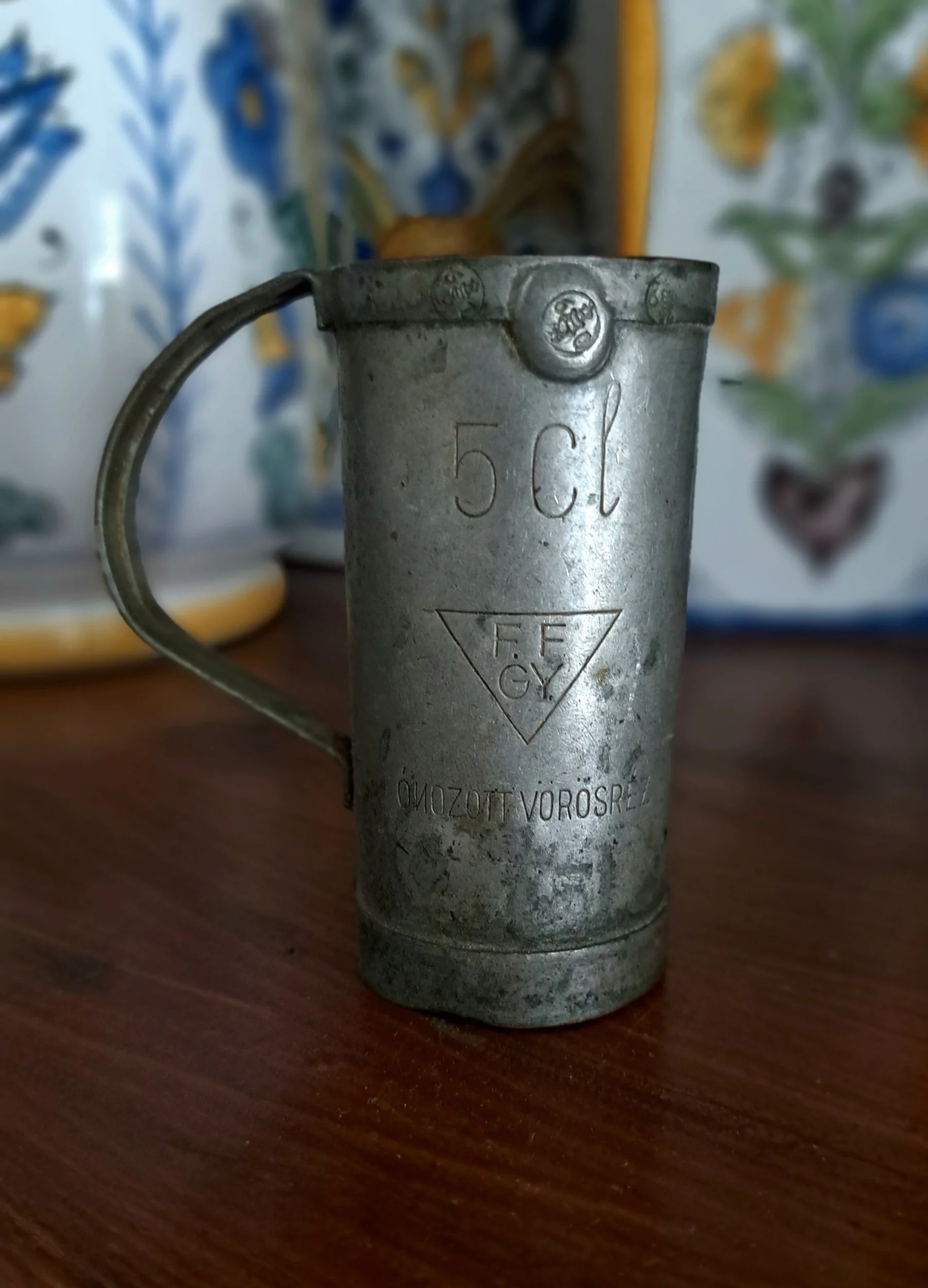
A Hungarian tinned-copper measure, probably first half of the 20th century
Some objects survive because somebody thought they were precious. Others survive simply because nobody bothered to throw them away.
I suspect this little Hungarian measure belongs to the second category.
It holds exactly 5 cl, or 50 millilitres. Not approximately a glass, not a generous splash, not whatever the barman felt like pouring. Five centilitres.
The body is copper covered with tin, identified by the Hungarian inscription ÓNOZOTT VÖRÖSRÉZ, meaning tinned copper. On the front is a triangular maker's mark, F.F. GY., whose manufacturer I have not yet been able to identify with certainty. Around the upper rim are several stamped marks which appear to relate to official verification.
That is where this rather battered little cup becomes interesting.
Hungary had formal rules governing measures used in public houses, restaurants and cafés. Alcohol could not simply be sold using any convenient cup. Serving measures had to conform to recognised capacities and be officially verified. Five centilitres was one of those recognised quantities.
So this was not merely something for pouring a drink. It was an instrument of commerce.
Imagine it behind the counter of a Hungarian kocsma. A bottle comes down from the shelf, the measure is filled, the contents disappear into a glass, and the little copper cup returns to the counter. Again and again. Pálinka, perhaps, although it could have measured other spirits.
The number 5 cl told the customer what he was buying. The official stamps told him, in effect, that five centilitres really meant five centilitres.
There is something wonderfully serious about that.
Today we tend to think of measurement as invisible. A petrol pump, supermarket scale or digital till quietly does the arithmetic for us. Here the transaction was physical. The quantity sat in someone's hand.
And the object carries the evidence of that life. The tinning is worn and stained. There are scratches, knocks and oxidation. The handle is purely functional. Nothing about it was intended to be beautiful.
Which is precisely why I have no intention of polishing it.
Its surface is its biography.
I don't know which bar it stood behind, who held it, or how many thousands of times it was filled and emptied. I don't even know yet who F.F. GY. was. Those unanswered questions are part of the reason it belongs in The Cabinet.
It is only a five-centilitre cup.
But for a moment, somewhere in Hungary, it was also the difference between a fair measure and a short one.
The Object
Object: Hungarian liquid measure
Capacity: 5 cl / 50 ml
Material: Tinned copper (ónozott vörösréz)
Origin: Hungary
Date: Probably first half of the 20th century
Markings: “5 cl”; “ÓNOZOTT VÖRÖSRÉZ”; triangular “F.F. GY.” maker's mark; multiple verification stamps around rim
Original use: Commercial measurement and dispensing of liquids, very plausibly spirits
Condition: Heavily used, with worn tinning, oxidation, staining and surface marks
Maker: Not yet identified
Cabinet rule: Do not polish
STATUS: COLLECTION
This object is currently not for sale.