The Camera Before the Photographer
My father was born in 1919.
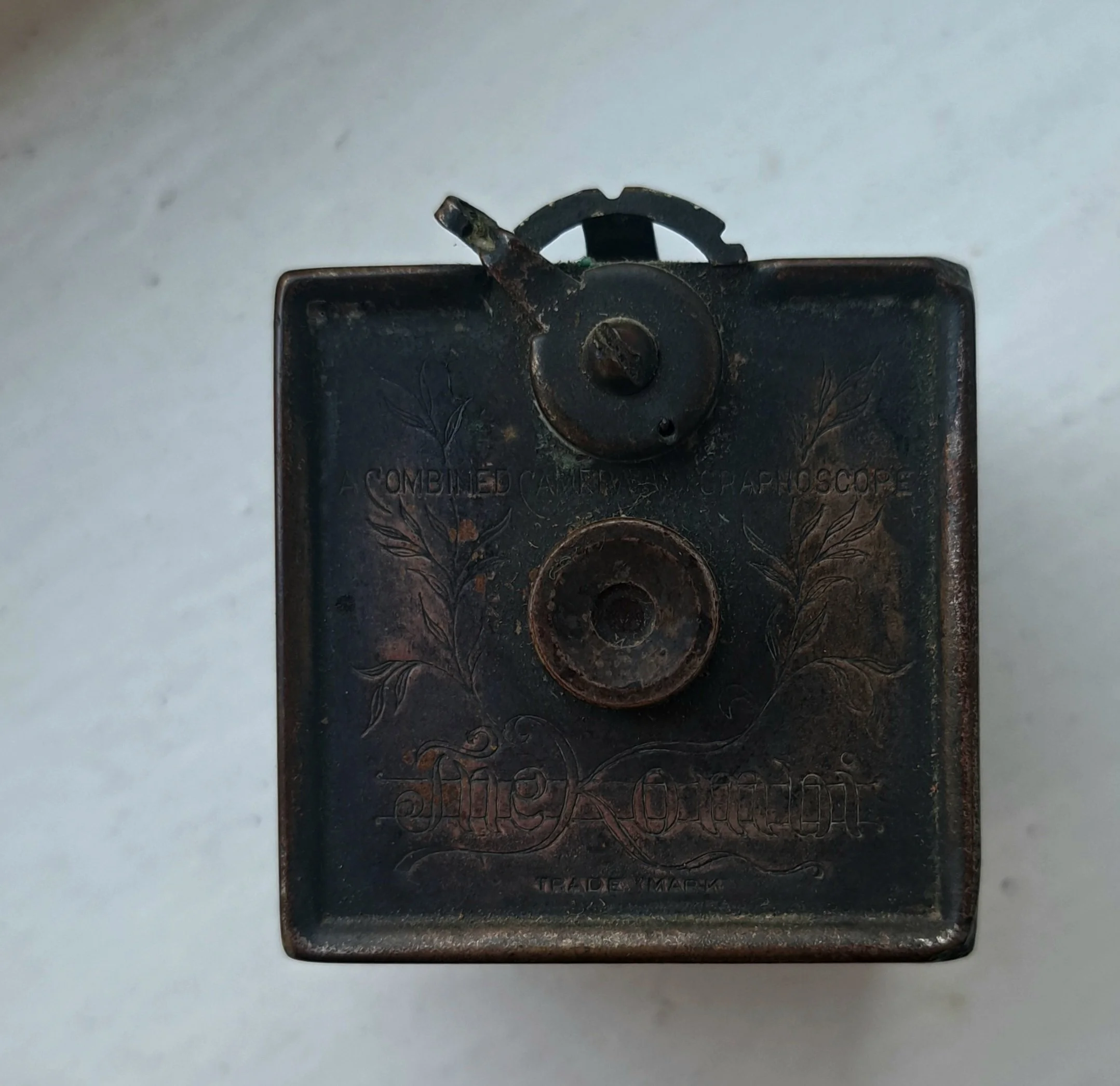
For many years he worked in Milan as an accountant at Lamperti e Garbagnati. Among the things that eventually passed from his life into mine was this peculiar little metal box.
I knew it as something that had belonged to my father. What I had never properly considered was what it actually was.
Engraved across its face are the words The Kombi.
It turns out that the little box is a camera, and a rather extraordinary one.
The Kombi was made by Alfred C. Kemper in Chicago at the end of the nineteenth century. The design was patented in 1892 and cameras were being produced by the early 1890s. Barely larger than a matchbox, it could make 25 photographs on a roll of specially manufactured film.
But taking photographs was only half its purpose.
After the film had been developed as transparencies, it could be returned to the camera. A small circular opening allowed light through the back and the photographer looked through the lens to see the pictures.
Camera and viewer in the same tiny brass box.
Hence the name: Kombi.
What interests me now, however, is not simply that it is an ingenious camera from the 1890s.
It is that it belonged to my father.
I don't know where he found it. I don't know whether he bought it in Milan, whether somebody gave it to him, or whether it had already belonged to somebody else. He was born more than twenty years after the Kombi first appeared, so there was already a history behind this little camera before it reached him.
And I never asked.
Perhaps that is one of the peculiarities of objects we grow up with. While the people who can tell us their stories are alive, the objects seem ordinary. They sit in drawers and cupboards and we assume there will always be another opportunity to ask.
Then, eventually, the object remains and the answers disappear.
My father kept the Kombi.
Years later, I became a photographer.
And somehow this tiny camera, made in Chicago more than 130 years ago, travelled through his life and ended up in mine.
I rather like that.
Not because I believe in destiny, and certainly not because an old camera somehow explains why I became a photographer.
But among all the strange things that could have survived from my father's life, a camera did.
That is enough of a story for me.
For your Cabinet information panel, we can now be much more precise:
THE OBJECT
Object: Kombi Camera and Graphoscope
Date: c. 1892–1895
Origin: Chicago, Illinois, USA
Manufacturer: Alfred C. Kemper
Inventor: William V. Esmond
Material: Brass with oxidised/silvered finish
Format: 25 exposures, approximately 1⅛ × 1⅛ in
Film: Special Kodak-manufactured roll film
Function: Miniature camera and transparency viewer
Provenance: Belonged to my father, born 1919
STATUS: COLLECTION
This object is currently not for sale.